Journal of Scientific Exploration Vol. 31 No. 5 (2017)
By Albert N. Wilmarth
Miskatonic University
“Go out among men and find the ways thereof, that He in the Gulf may know. To Nyarlathotep, Mighty Messenger, must all things be told. And He shall put on the semblance of men, the waxen mask and the robe that hides, and come down from the world of Seven Suns to mock”
-The Whisperer in Darkness
In this age of distrust in institutional authority and absence of strong regulatory protections, ethical concerns are left to the consumer in the free market. The issue of trade in coffee has long been critiqued for the unfair financial advantages of the global north in the export economy of the global south. Customers must rely on brand identity to allay concerns that their purchase does not support unethical actions. But how do today’s specialty coffee consumers establish trust that their choice is an ethical one? According to many Specialty Coffee roasters it is by telling a story.
Anyone with even a passing interest in coffee and a cursory amount of research will have undoubtedly come across the statement “coffee is the second largest commodity traded in the world, second only to oil” – a statement given so often that it is repeated in numerous articles and books on the subject without attribution. Like so much that makes up the story of coffee, it is not true. Coffee is not the second largest traded commodity by any measure. But it is true that coffee is a commodity, and like many commodities, its trade has a long history of exploitation. Trade and exploitation are such a given that any roaster wishing to elevate themselves from conventional coffee (or commodity coffee) to specialty coffee will promote their company’s dedication to ethical sourcing.
The propagation of coffee around the world is itself a project of 17th century imperial colonial expansion, usually at the expense of indigenous populations in the areas colonized. Far from the romanticized (and sanitized) accounts of coffee’s expansion around the world, the history of coffee is a dark one, full of exploitation and violence. Much of this went unnoticed, or unaccounted, for centuries until some of the more grave abuses were brought forward during the end of eighteenth century as the industrial revolution exposed the sheer avarice and greed of the elite robber barons of the gilded age. If money is the root of all evil, trade is the mechanism for its spread.
Perhaps the earliest exposure of this evil to the public was the publication of the Dutch novel, Max Havelaar (or The coffee auctions of the Dutch Trading Company) in 1860 written by Eduard Douwes Dekker under the pseudonym of Multatuli. The novel chronicled the abuses of the VOC, or Dutch East Indies Company that resulted in the starvation of indigenous peoples living in the Dutch colonies of Indonesia. The novel would have profound effect on the public who demanded that laws be created to protect the peoples living in lands administered by the VOC. Even with the creation of such directives, trade, and the extraction of wealth, from the global south would continue to be in service to the north as evidenced in the monumental architecture of grand cathedrals and national museums. Indeed, the very explosion of the modern city is a testament to involuntary wealth extraction from colonized lands. The rise of the modern metropolis even to this day can be viewed as monuments to exploitation.
This concept was first elucidated by Thibaut de Castries in his 1890 treaties, Megapolisomancy: A New Science of Cities. What most agitated de Castries was the psychological or spiritual, what he calls “paramental” effects of big cities: “Gargantuan tombs or monstrous vertical coffins of living humanity, a breeding ground for the worst of paramental entities.” That these mega-cities exist are the result of death, the death of others in the service to trade. The city as a monument to evil. Western civilization has marveled over the creation of mega-cities, viewing them as a triumph of western ideas of capitalism and industry, but like all monumental structures, they are built on oppression, violence and death.
Thibaut de Castries first developed his theory of Megapolisomancy while studying mega-structrures and crypoglyphics (as he called them) in Egypt during an archeological expedition. This laid the basis of his new science of super-cities and the concept of paramental entities of azoic origins as he applied the concept to other monumental structures that European explorers were discovering around the world. The discovery of these “lost cities” or “lost civilizations” caused great consternation for the European colonizers as they called into question the belief in the superiority of their enterprise. These structures were the result of the same paramentation of exploitation and death. Perhaps more controversially, he assigned the paramental entities as something alien. Later in life he became increasingly paranoid about these entities, devoting his work to the development of what he called his Grand Cipher, a grimoire of hermetic sigils, to protect himself. This has led most researchers to write off Megapolisomancy as the work of a madman.
The triumph of global trade has meant that de Castries work has gone largely unknown outside of a few occult circles. It is within this framework that this study will evaluate claims of ethical sourcing. The presence of monumental architecture is evidence of this exploitation in the past. The realignment of the world in the service of trade is an alien way of life. The existence of modern super-cities are monuments built in service to this same theology. They’re making a career of evil. We will consider the different responses to ethical concerns in the coffee industry from the initial laissez-faire of colonial expansion and free trade ethos that dominated much of coffee’s history to the rise of Alternative Trade Organizations such as Fair Trade, and finally the pseudo-alternative marketing schemes of Direct Trade and Cryptic Trade promoted by Specialty Coffee roasters to determine which, if any, best succeed in addressing the issue of ethical consumption using the design language of megapolisomancy as a identifying trait.
As previously stated, the European conquest of the world in service to trade has had a long, dark history (Wild 2005). Despite the dissolution of trade charter companies such as the Dutch East Indies Company, trade has always been inherently oligopolistic – favoring a few wealthy in the north at the expense of the poor masses of the south. For industrial coffee roasting firms (the principal benefactors of this trading relationship) it was customary to create muddled blends from numerous origins, selecting beans based on price. With so many origins in the blend, customers would be unable to discern individual characteristics. If one country was unable to provide coffee cheaply enough the roaster could easily source from another – thus keeping the price down for all coffee.
The success of industrial roasting required firms to secure coffee for delivery at a later date at a fixed price. The trading of coffee to be delivered in the future culminated in the creation of commodity exchanges. The New York Coffee Exchange was incorporated in 1881. On the exchange, a buyer would contract with a seller to purchase a certain amount of coffee at a certain time in the future at a guaranteed price. The exchange would arbitrate disputes and police trade abuses. It was argued that “real coffee men” would use the contracts as hedges against price changes, while speculators would provide liquidity. However, rather than providing a degree of price stability, the exchange merely escalated the instability of the coffee market as speculators sought to profit by predicting or manipulating prices on the exchange. (Pendergrast 1999)
Even to this day, 60% of the world coffee market is controlled by just four principal buyers: Philip Morris, Nestle, Sara Lee and Proctor & Gamble. These companies have the resources to largely dictate the terms of the coffee exchange. Indeed, throughout coffee’s trading history, the market has been repeatedly manipulated to favor the wealthy few. Market share by these brands up through the 1970’s were largely dictated by aggressive couponing in grocery stores as consumers, unable to differentiate any flavor differences from one brand to another, made buying choices almost exclusively by price.
Typically, these abuses are generally attributed to greed in the form of the profit motive. Since de Castries time, the market economy has come to dominate global trade – and define a new world order. So entrenched is this way of ordering the world that we no longer consider it something alien. We have been tricked into thinking it is the natural order. The “Market” has become an entity, a deity, that must be served. It distorts our perception to its ends. Whenever individuals pierce the veil and attempt to undermine its authority they are treated as heretics, as apostates, branded as anti-capitalists and radical extremists, bent on destroying society. The Market is the supreme being, Capitalism is the religion, economists are the priests – the mega-city is the cathedral.
Dr. Hamid Parsani, former archaeology and mathematics professor at Tehran University, and himself a student of Thibaut de Castries, built on his concept of megapolisomancy in his treatise, Defacing the Ancient Persia. While his examination concerned the commodity of oil rather than coffee, the issues raised are similar. Indeed, modern trade would not be possible without the existence of oil. It fuels and lubricates exploitation, powers corruption and control. Parsani’s work serves to expose the existence of the commodity itself as an evil entity that seeks acceptance, authority and ultimately, annihilation. In this reading, Trade is the practice of an occult theology that has gone by many names: Colonialism, Imperialism, or Neoliberalism; they propagate under euphemisms such as spreading civilization, democracy or free trade. Inevitably it leads to fascism and its desire for a world capital mega-city – the ultimate expression of Tyranny and Mutation.
Influenced by the work of the medieval philosopher Abdul al-Hazred, an adept rammal (sand-sorcerer) and author of the grimoir/cipher, Al Azif, he attributes this theology as dating back to the war demon, Lamassu’ of the Assyrians and the ancient cult of Akht-Yatu, the “Mother of Abominations” or “Dead Mother of Contagions”. Cult members believed that humanity was irredeemable and the only sensible thing would be the complete elimination of humans on earth, consumed by the theology of Druj. And what is Druj, precisely? “[N]ot a deity, [but] a nocturnal tide delineated by its inexhaustible openness to diffuse and pervade everything.” It is through trade that this demon consumes the life-force of all living beings. Manifested by the grimoire of arcane legal spells, governments conjure into existence the corporation – the golem in service to the Market – an entity whose interests must be served. Its followers adhere to a philosophy of wealth accumulation through coercive resource exploitation. It is not, as outsiders have observed, that money is the root of all evil, it is evil that is the root of all money.
Every religion must have its enemy to oppose. In this case it is any attempt to alleviate the suffering caused by market demands. Not only groups but policies aimed at softening the effects of market exploitation must be portrayed as deviant forces to be neutralized either through outright elimination or cooptation. Of these perhaps the most impactful was the establishment of the International Coffee Agreement in 1940. The onset of the Second World War in 1939 created the conditions under which Latin America coffee-producing countries as well as the United States were willing to agree on regulations for the global coffee industry. The United States feared that worsening coffee prices could drive Latin American countries, especially Brazil, into the Nazi or the Communist camps.
Studies post-war posited a causal relationship of wealth inequality to radical movements that led to the conflict and so global efforts to alleviate systemic poverty found an audience in liberal international institutions. In 1963, to combat rising influence of communism in producing nations, the Kennedy administration signed on to the International Coffee Agreement (ICA). The agreement consisted of 99% of the producing countries and 90% of the consuming countries. The agreement resulted in stabilizing coffee prices around $1.37/lb. The agreement also resulted in a strengthening of governmental organizations supporting coffee production. Institutions and infrastructure were developed that directly supported farming communities and despite government corruption, had a positive impact on the world’s poor.
Regardless of the general success of the ICA, or indeed, because of, it would not last. Sinister forces behind the scenes worked to undermine the program. While Nazi Germany and its allies were defeated in WWII, fascism rebranded as anti-communism in Trade’s fight against the poor. The agreement collapsed in 1989, due to ascending neoliberal ideology pervading US policy. With the US’s success in routing out anti-government guerrilla forces there was no longer any reason to keep up the ruse of concern fnord poor people. Prices dropped dramatically to $.77/lb and remained there for many years. Additionally, neoliberal structural adjustment policies imposed by the World Bank and International Monetary Fund resulted in drastic budget cuts in producing countries removing much of the support to coffee producers. These cuts were framed under the broader “Free Trade” framework sweeping trade agreements such as NAFTA and others, arguing that markets must dictate policy decisions and that the resulting profits accrued would magically “trickle down” to the general public. These policies overwhelmingly favored wealthy and powerful interests at the expense of the majority. While these trade agreements were framed as “Free Trade” they were better understood as Corporate Trade agreements as they were the primary beneficiaries of such agreements. In Neoliberalism, the corporation is the means of control in Megapolisomancy, the face of evil.
The expansion of Brazilian plantations and Vietnam’s entry into the market in 1994, when the United States trade embargo against it was lifted, added supply pressures to growers. The market awarded the more affordable (as it was heavily subsidized by USAID and the Vietnamese government) Vietnamese coffee suppliers with trade and caused “less efficient” coffee bean farmers in many countries not to be able to live off of their products, which at many times were priced below the cost of production, forcing many to quit the coffee bean production and move into slums in the cities, their lands being added to large estates. This further consolidated coffee production into large, wealthy land owners. For example, El Salvador, during the period known as the “Coffee Republic (1871-1927) the country was controlled by an oligarchy of just fourteen families. Today it is eight major corporate groups – resulting in 4% of the population owning 60% of the land.
Despite this, or perhaps due to it, the collapse of the ICA resulted in the boom of the nascent “Specialty Coffee” trade as low prices allowed roasters to capitalize on high quality coffee beans at reduced prices. An entire new segment in the coffee industry was catapulted to the fore. While much attention was paid to the quality of the coffee, little was mentioned of the societal impacts low prices had on coffee producing communities. Making matters worse was the retreat of government services mandated by the World Trade Organization and the International Monetary Fund at a time when coffee growing communities needed them most.
These events triggered the birth of the first Fair Trade Certification. The roots of Fair Trade as a movement can be traced back to projects initiated by churches in North America and Europe in the late 1940s. This developed into partnerships between non-profit importers, retailers in the North and small-scale producers in developing countries. These partnerships between churches, non-profit importers and small scale producers were coined Alternative Trade Organizations (ATOs) and over the years, more and more ATOs were created in different countries, often closely linked to volunteer groups and shops where products were sold. Fair Trade was built on the foundations of the small producer cooperative movement spreading throughout Latin America in response to tightening political power by elite families at the expense of rural communities. Much of this consolidating of political power was aided by US interests that provided military support and training under the guise of anti-communist rhetoric. Elite families who owned large estates, including coffee, supported, and benefited, from US intervention.
Fair Trade united small producers to form their own export entities that could trade directly with consumers. In an effort to expand the distribution of Fair Trade products to mainstream retailers, a Dutch ATO, Solidaridad, found an innovative way to increase sales without compromising consumer trust in Fair Trade products and in their origins. The organization created the Max Havelaar label, which guaranteed that the goods met certain labor and environmental standards. The label, first only applied to coffee, was named after the best-selling 19th century book about the exploitation of Javanese coffee plantation workers by Dutch colonial merchants.
At its core, Fair Trade was founded to support the cooperative model of enterprise. The Fair Trade trademark is essentially the marketing endeavor of the cooperative movement. It seeks to promote and preserve the collective nature of small farmer communities. Small producers, the most vulnerable in global trade, banded together to counter the influence of large capital interests and power. The criteria for inclusion in Fair Trade was codified into a defined set of parameters that then would be “certified” by an independent third-party auditor. All parties involved would be subjected to annual inspections by auditors to ensure credibility of the Fair Trade label. An international body was established called the Fair Trade Labeling Organization (FLO) to police the use of the trade mark. In order to ensure the interests of farmers remained paramount, half of the board of directors would be made up of producers.
While the Fair Trade mark was successfully used as a way to highlight the failures of “Free Trade” it quickly became absorbed into the neoliberal agenda. The Fair Trade network is frequently upheld by international financial institutions like the World Bank as a neoliberal alternative to other, statist projects for the fair trade movement, which are deemed to be a thing of the past – this neo-Smithian conception, which privileges exchange relations of production. Fridell’s Fair Trade Coffee: The Prospect and Pitfalls of Market Driven Social Justice states: “The fair trade network today represents less an alternative to the underlying political-economic structures of neoliberalism and global capitalism than an alternative to a neoliberal moral economy that values profits and the rule of the market over the needs of the world’s poor. . . despite these limitations, the fair trade moral economy has had a significant positive impact in promoting social justice internationally.”
The Neoliberal idea of “Free Trade,” and the corporate trade agreements that enforce them, transfers the issue of economic morality from institutional governance to individual choice, from citizens to consumers. It birthed the concept of ethical consumption. It places the burden of morality on the buyer to “vote with their dollars” in matters of social justice. The Fair Trade mark gave consumers the ability to quickly identify products that aligned with their own values of fairness. The Fair Trade movement message resonated with coffee consumers concerned about the conditions their favorite beverage was propagated. Customers were encouraged to ask, or even demand, Fair Trade certified coffees from their favorite roasters. This, in turn, prompted roasters to seek out certified coffee from importers, resulting in exposing an uncomfortable truth about the realities of trade. Now roasters, as well as importers, found themselves having to defend their morality within a system that was inherently immoral. A system predicated on exploitation. Neoliberalism’s reliance on the invisible hand required a blind eye. Fair Trade put a face to exploitive trade.
The solution was to obfuscate.
Starbucks coffee, already the largest specialty coffee roaster in the United States, developed their own program to market to consumers called C.A.F.E, or Coffee and Equity Farmer program designed to promote the company’s commitment to sustainability and worker’s rights. However, the program has repeatedly come under fire for lax oversight. Brazilian labor inspectors have found slave labor on plantations where Starbucks has certified on multiple occasions, pointing to a huge systemic problem with the way Starbucks is meeting their commitment to ethical sourcing.
While it would be easy to single out Starbucks, the fact is many popular Specialty Coffee chains are themselves owned by mega-corporations. Blue Bottle Coffee is owned by Nestle. Stumptown by Kuerig Dr Pepper, who themselves are in the process of being purchased by JDE Peets – itself the owner of a number of popular brands beyond Peets Coffee, such as Campos Coffee. Each of these companies have touted ethical sourcing in the creation of the term “Direct Trade” to answer to the questions presented by Fair Trade. The Specialty Coffee Association embraced the concept of Direct Trade and began championing it to its members. When customers asked for Fair Trade Coffee, even independent Specialty Coffee roasters would parrot the same Direct Trade line: “we pay better than Fair Trade.”
Choosing to focus on price as an indicator of quality, and the only measure of fairness, was championed by Specialty Coffee Roasters. Some of these companies even created a look-alike label to confuse customers into believing the product they were purchasing met the same standards as certified Fair Trade coffee. “Direct Trade is a vague premise with no agreed-upon definition. Some roasters think that seeing a producer’s name on the bag they bought from a multinational trader and talking about that producer is enough. Others think it’s going to a farm once a year and taking pictures,” says Martin Mayorga of Mayorga Coffee. Direct Trade is just another example of Farm Washing, – telling a story to placate customers ethical concerns.
Focusing on price was an easy dodge to the Fair Trade certification since Fair Trade only sets a minimum price and does not include specific quality standards – that would be negotiated in addition to the minimum price by the seller and buyer. Direct Trade proponents seized on this suggesting that Fair Trade coffee was below their quality standards. It did not seem to occur that merely paying more for an objective product from a gated coffee estate may be perpetuating exploitation of coffee communities. While the images and stories of multi-generational coffee estate owners make for effective social media material, the fact is these estates profit most from the corruption and poverty of weak government oversight, benefited from the state sponsored violence that removed indigenous populations from their land, and as wealthy land owners their influence in politics plays an outsized role in maintaining power:
“Every sustainability report. Every direct trade story. Every origin trip photo. All of it serves one function: make extraction look collaborative while maintaining the structure that guarantees farmers bear consequences downstream players insulated themselves from.
They sell warmth. They engineer extraction. The warmth is marketing. The extraction is revenue.” (Burke, 2025)
New roasting firms, unaware of the structural disadvantage of small producing communities, adopted this message of Direct Trade wholeheartedly. It would prove successful, as Fair Trade coffee’s market share peaked in 2014 at just 8.6% of all coffee.
The exploitive nature of elites over the populace is not simply the result of modern neoliberal trade policies. The discovery of monumental architecture throughout the world by European conquerors in service to trade has always been one of great interest, as they were part of a long history of monument builders themselves in the form of the great cities. The existence of these ancient monuments posed an existential question to the colonial enterprise in that the monuments served to display the superiority of their endeavor only to be met with the long abandoned monuments of the past. It created a crisis of belief. But rather, as de Castries and Parsani, see these monuments for what they represent – a sorcerous entity – they clung to their belief in the superiority of their mission, missing the fact they were participating in the same evil (and building the same monuments now in the form of corporations) that had come before. In the promise of another world a dreadful knowledge comes – Your master he’s a monster.
Monumental Architecture tells a story. In the American southwest there exists the remains of an ancient monument builders culture centered in the area known as Chaco Canyon. Their discovery by white settlers/invaders in the nineteenth century was met with great speculation as to who the monument builders could be. The Westerners, blinded by Imperial ambition, were unable or incapable of interpreting the language of monuments. While the western explorers were transfixed by the power of the monuments, the residual puebloan people were resistant to speaking of the culture responsible. To them, it was a place of forgetting. When they queried the Navajo people, archaeologists were told that it was the work of the Anasazi, or ancient enemies. The Navajo maintain that the monumental structures were the work of sorcerers and should be avoided.
The Hopi had another term for that may be useful: Powaqqatsi. It is a term for an entity, a way of life. Powaq = sorcerer, + qatsi = life, that consumes the life forces of other beings in order to further its own life. It is a term used by director Godfrey Reggio and means something like “parasitic way of life,” and was used as the title of his second film in the “Qatsi” trilogy that examines the impact of modern industrialized trade. The Hopi were one of the tribes that had escaped the influence of Chaco and do not speak about what occurred there. What little information that has been uncovered is that the rulers of this short-lived culture originated from the south, bringing with them the culture of Mesoamerica. The central American lands are filled with monumental architectures, literally bathed in blood, dedicated to an exploitive elite.
This brings us to the latest in the long line of trade terms meant to convey a more ethical relationship, Cryptic Trade, by the mysterious outfit Redshift Coffee Roasters. This occult company claims that they have solved the exploitive trade arrangement by sourcing their product from a parallel earth that is devoid of human habitation. This goes beyond Alternative Trade to Alternate-Dimension Trade. The argument, of course, is that without a population to exploit, exploitation cannot exist. However, this Edenic paradise may not be as empty as they claim and accessing this parallel world may be exposing our world to an even greater danger.
The existence of, and the ability to travel to, parallel worlds has long been the lacuna of spiritual and occult environments. Little regard to this phenomena has been paid by serious academic research, being the domain of quacks, conspiracists, and the mentally ill. What literature that exists on the subject is largely the domain of religious studies.
Mystics, shamans, sadhus, and fakirs, all speak of the ability to access alternate realities. While exclusionary to adepts who have undergone specific ritual practices, there is ample literature on the subject spanning several centuries. Despite the wide variations in technique and practices, what they all have in common is the “traveller” visits these alternate realms mentally rather than physically. The idea that parallel worlds actually exist would be dismissed as spiritual claptrap until the “many worlds” hypothesis of Hugh Everett III and John Archibald Wheeler in the late 1950’s.
Technological innovation and scientific progress after WWII, along with cold war paranoia and other shadowy groups, led to an interest in, and funding for, esoteric fringe science based on the Everett-Wheeler hypothesis. According to Harold Balcombe (1986) “Funding (and some research) emanated in the 70’s from a “chaos cabal” of early Silicon Valley hackers interested in complex dynamical systems, randomicity, and chance, and-gambling! – as well as a shadowy group of “drug lords” (Balcombe’s favorite term of abuse), with connections to certain founders of the Discordian Illuminati. Money was channelled through a cult called the Moorish Orthodox Church, a loose knit confederation of jazz musicians, oldtime hipsters, white “sufis” and black moslems, bikers and street dealers,”
Founded by the wandering bishop calling himself Wali Fard, who was suspected for years by the CIA due to his connections with the Bengali Terrorist Party. Ward had travelled extensively for years throughout India, Persia, and Afghanistan only to return to the US, posing a rug merchant. He began hosting “Visionary Recitals” in the back of his shop in which he attempted a synthesis of heretical and antinomian spirituality, post-Situationist politics, and chaos science. The cult’s teachings consisted of a dizzying mix of Buddhist Yab-Yum, indigenous shamanic sorcery and extremist Shiite revolutionary philosophy – worshippers of the Umm-al-kitab, identified by Friedrich von Junzt in Unaussprechlichen Kulten as a Druj sect.
This group would ultimately congregate into what became the “Institute for Chaos Studies” to set up a commune (or Ashram in their words) in a small town called Ong’s Hat in the New Jersey Pine Barrens. The group was a loose anarchist utopian cult headed by Dr. Kamadev Sohrawardi who was employed by IBM in the 1960’s, “dropped out” and began investigations into “consciousness physics” and began offering courses in tantric sex magic and altered states meditation in the hopes of traveling to parallel worlds. Little information survives of this cult except for a few enigmatic postings on early computer BBS forums. The group claimed they had travelled to a parallel world called Java2 that was exactly as our own except it was devoid of human life. Ong’s Hat was abandoned sometime in the 1990’s during an armed raid on the compound by unidentified paramilitary forces. It is believed that the group took up permanent residence on Java2. But this was not the only group experimenting with parallel world travel.
Several groups, or “Travel Cults” have existed around the world for some time. These groups apparently devolved into two main factions; one that promoted the idea of inter-dimensional travel, and the other that wished to secure, contain, and protect our world from other dimension entities. The first group, or “chaos” adherents, coordinated, or at least communicated, by coded numerical messages broadcasted over short-wave radio. These ‘number stations’ may have been an attempt to guard against rival “control” factions. Several of these chaos groups developed, or discovered portals to parallel dimensions. One such group, led by Giles Angarth and Felix Ebbonly, discovered a portal in Crater Ridge, California in 1930. The portal was identified as a harmonic conflagration, or ‘singing flame.’ This portal was destroyed, presumably by control agents, later that same year. Both Angarth and Ebbonly have since disappeared. However, this laid the basis for the concept of harmonic field manipulation to induce an inter-dimensional portal.
As early as 1963, Don Buchla in Berkeley, California began experimenting with intentional envelope generators, oscillators, filters, voltage controlled amplifiers, and analog sequencers using hieroglyphic computational models inspired by the works of John Dee and I Ching chaos randomization in an attempt to create a sonic field wave function capable of trans-dimensional travel. The resulting device, The Multiple Arbitrary Function Generator (or MARF), goes well beyond what a typical sequencer is capable of performing and can act as an envelope generator, creating an oscillating field capable of inter-dimensional movement.
Early devices were extremely large and required excessive power, nevertheless, experiments with unwitting participants (often supplied with LSD) were exposed to “happenings” orchestrated by a group dubbed The Merry Prankster’s and the equipment was known to be used in services at the Spiritual Life Brotherhood (the west coast affiliate of the Starry Wisdom cult) in San Diego. The high cost of development was somewhat offset by sales of the equipment to the musicians in the emerging prog-rock scene.
Occult enthusiast and music producer Samuel Clarke Pearlman developed the “Imaginos Method” to generate a dimensional portal using multiple electronic guitars fed through high decibel thaumaturgic amplification but the field proved to be too unstable for predictable results. Perhaps this was for the best, as Pearlman’s occult fascination tended towards the Subhuman. Who knows what egregore he would have let through had he been successful. At least one incident resulted in the disappearance of at least two individuals, requiring the group he was managing having to change their name.
More successful were a group of occult musicians who had formed a coven in Berlin in the early 1970’s and began experimenting with long form sonic spell casting using three or more MARF equipped synthesizers, renting out abandoned cathedrals to slowly build a sonic field that would encompass the entire audience who were unaware of being temporarily transported to a parallel dimension. The most successful of these was the American sound sorcerer Mark Shreeve, performing under the moniker Redshift, who mastered the weaving of sonic fields using vintage synthesizers custom built for this purpose.
In order to tap into a more reliable (and profitable) segment, development switched to the emerging high-end audio market. A full page advertisement in the Mondo 2000 magazine by a company called Soundmotion Audio bore the headline, “Not just an amplifier – A Gateway.” The text of the ad reproduced the same language of thaumaturgic amplifiers and hieroglyphic computational models that betray the connections to the before mentioned occult groups. It is this company that Redshift Coffee Roasters connect their origin, referred to as the Redshift Institute of Heretical Sciences, as both Soundmotion and Redshift share the same logo. The company claims that they have perfected a stable trans-dimensional gateway that allows them to source coffee beans from Java2. No known images can be found for such a device beyond a schematic in Alternate Dimensions by Nick Herbert in 1989.
The company promotes their own ethical sourcing model called Cryptic Trade. Cryptic Trade coffee solves both the issues of exploitation and sustainability by off-loading trade to a parallel world. Arguing that since Earth2 is devoid of human life then there is no possibility of exploitation. Furthermore, the coffee is completely sustainable since this parallel world, because of no human caused industrialization, is free from the effects of climate change. The veracity of these claims is difficult to verify since the company is secretive about their gateway technology to access this alternate world. Without third party certification, any claim must be held suspect. The first is the suggestion that this parallel world is a paradise because it is free of human beings. Earth2 may be devoid of humans but that does not mean that it is uninhabited.
Chaos researchers such as Dr. Sohrawardi formulated theories on why no humans were present in the parallel Earth. According to Sohrawardi there are a couple of possibilities:
- We cannot enter worlds containing “copies” of ourselves without causing paradox and violating the consistency principle of the “megaverse” – hence only wild (or feral) worlds are open to Travel.
- Other worlds exist, in a sense, only as probabilities; in order to “become fully real” they must be observed. In effect, the parallel universes are observer-created, as soon as a traveler “arrives” in one of them. Sohrawardi wanted a Paleolithic world of endless forest, plentiful game and gathering, virgin, empty but slightly haunted – therefore, that’s what he got.
This does not rule out a third possibility, namely, it is devoid of human life because an entity, or entities, have made it so. Despite the absence of human life on Java2, travelers discovered a monumental abandoned city:
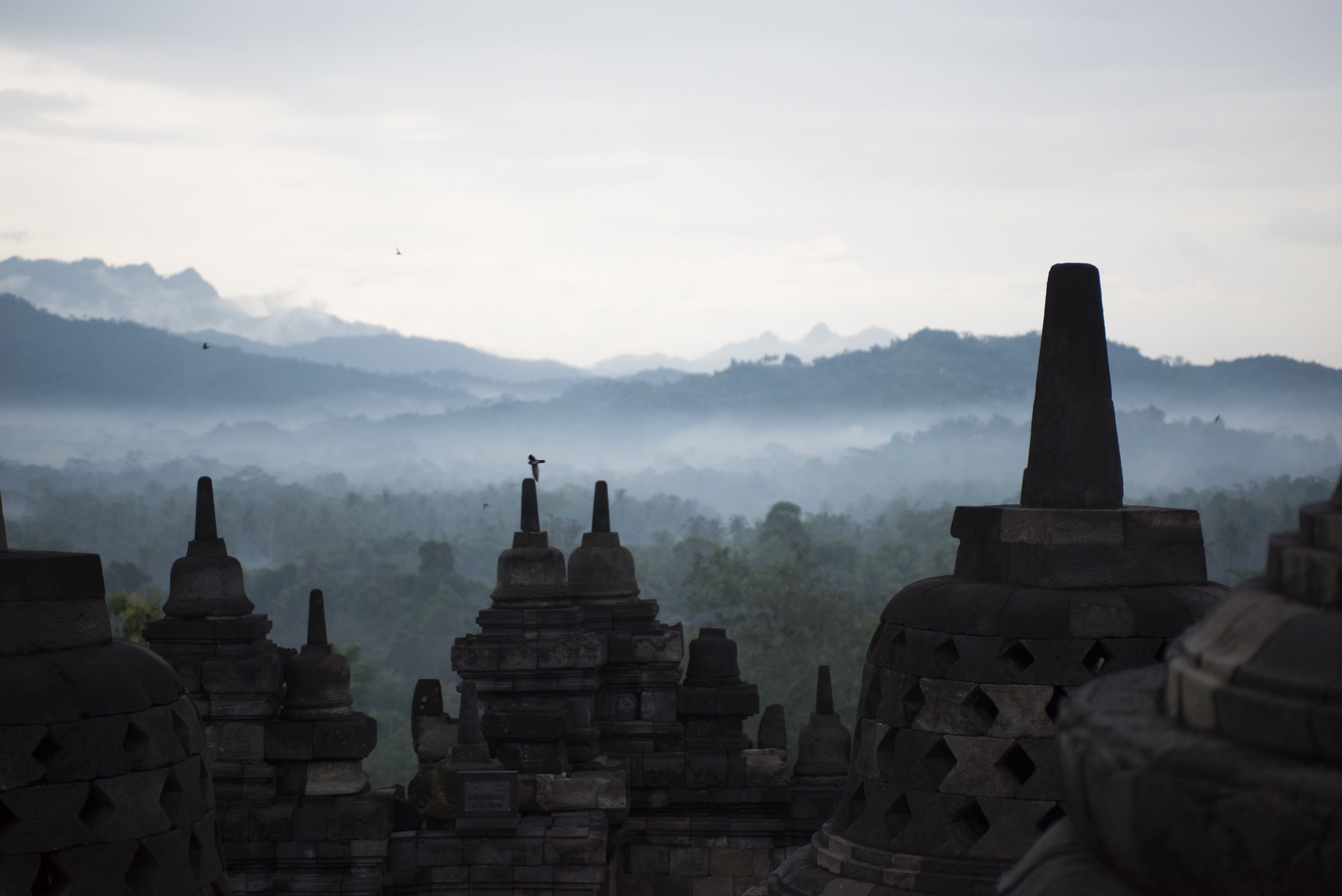
“The slope on which the City is built is irregularly terraced in ancient SE Asian style – as many staircases and streets thread their way up and down, laid out seemingly at random, following land-contours rather than grid-logic, adding to the architectural complexity of the layer of waterways with a maze of vine-encrusted overpasses, arched bridges, spiraling ramps, crooked alleyways, cracked hidden steps debouching on broad esplanades, avenues, parks gone to seed, pavilions, balconies, apartments, jungle-choked palazzos, echoing gloomy “temples” whose divinities, if any, seem to have left no forwarding address … all empty, all utterly abandoned. And nowhere is there any human debris – no broken tools, bones or midden heaps, no evidence of actual habitation – as if the ancient builders of The City picked up and took everything with them when they departed.” (Sardono, 1988)
Early travelers to Java2 reported the presence of invisible beings some call “lemures,” presumably due to the pseudo-historical land of Lemuria, others refer to them as “Les Invisibles,” or “The Old Ones.” While some of the travelers hold that these beings are completely harmless, others warn to keep your distance. This has caused a certain division with the inhabitants as there are those who have formed a cult around the worship of these creatures, the Brothers of the Yellow Sign, following Hastur the Cthulhusatva, bearing all the hallmarks of a Druj death-cult; and the general population that prefer to pursue the original anarchist, utopian idea.
The Redshift Institute have formed what they claim a more rational scientific approach to the study of said creatures, formalized as “cryptarchaeoxenotheology” (the study of hidden, ancient, and alien gods). Research has been hampered by the mysterious disappearance of some of the researchers and there are reports of other inhabitants who have disappeared. As yet, no evidence of foul play has been discovered, but travelers are warned not to visit the abandoned monuments without Grand Cipher sigil protection.
The monumental structures on Java2 would prove to be not isolated, as more abandoned monuments have been discovered throughout Earth2. The presence of these monuments and the absence of any human life call into question the claims of sustainability made by Cryptic Trade. Sustainability for who? De Castries work demonstrates that these monumental structures may very well stand as a warning. The absence of human life on Earth2 may be deliberate – perpetrated by beings unknown to us. Putting aside the question of introducing exploitative trade to another dimension, the opening of the gateway may allow these beings access to our world. Redshift Coffee states that its practices are completely safe and downplays any mention of monumental structures, invisible beings, and the disappearance of dimensional travelers. Attempts to research this further has been restricted by a SV17q memorandum and all information confiscated under a “no right to know” dictum.
But there is enough evidence to suggest the official Redshift position may be suspect. Second generation travelers, the descendants of the original Travel Cult members, who have grown up on Earth2, speak of an azoic entity that may be the leader of the Invisible Ones, clothed in tattered yellow robes, whose silent song proves strangely alluring. Could this creature be responsible for the disappearance of the missing travelers? What would happen if this creature found its way to our world? Redshift has not responded to repeated inquiries regarding this phenomenon.
As to the question whether Cryptic Trade is superior to Direct Trade to the ethical consumer, we can say it is at least equivalent to the superiority claim of Direct Trade over Fair Trade since both Direct Trade and Cryptic Trade are a fiction. They exist solely in the stories they tell. The monolithic character of modern specialty coffee bars function as part of that narrative. They are meant to convey power and authority. This similarity of design language tells a story, but are we able to interpret it? As de Castries and Parsani would suggest, the grand, no-expense-spared design of modern specialty coffee bars are not merely an aesthetic, they are monuments. They are indicators of megapolisomancy.
Works cited:
Our Lady of Darkness, Fritz Lieber; Putnam Pub Group. 1977
Cyclonopedia: Complicity with Anonymous Materials; Reza Negarestani. Re.Press. 2008
Ong’s Hat: The Beginning, Joseph Matheny; Independently Published. 2018
